

Post-Quantum TLS
Ph.D. thesis on post-quantum cryptography in TLS. I investigate current proposals for post-quantum TLS, but more importantly we propose a more efficient TLS handshake that makes …

Ph.D. in Post-Quantum Cryptography
2018-09-01
2024-01-09
Radboud University Nijmegen
MSc in Computing Science
2015-09-01
2018-08-31
Radboud University Nijmegen
Thom Wiggers is a cryptography researcher at PQShield. His research focuses on the design, formal analysis, and standardization of post-quantum cryptographic protocols.
Building on his PhD research into KEM-based authentication (KEMTLS), he has recently worked on redesigning Post-Quantum WireGuard using reinforced KEMs and providing a comprehensive deniability analysis of the Signal handshake protocol.
In the IETF, Thom is active in the PQUIP, PLANTS, and TLS working groups. In the TLS working group, he is a member of its formal analysis triage team (FATT). He is currently working on standardizing state and backup management for stateful hash-based signatures and has co-authored the AuthKEM proposal for TLS.
Ph.D. thesis on post-quantum cryptography in TLS. I investigate current proposals for post-quantum TLS, but more importantly we propose a more efficient TLS handshake that makes …
We present an alternative to TLS 1.3, by authenticating using only Key-Encapsulation Mechanisms. This allows us to get rid of handshake signatures, as post-quantum signature …
Migrating TLS to PQ seems easy. Just write in “PQ” and “KEM”, and we’re done, right? In this talk, I will show that things are unfortunately not that easy. Just using ML-DSA may …

I presented a Formal Analysis Triage Team report on Extended Key Usage (EKU) in the TLS working group session.
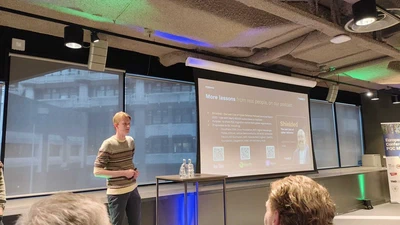
Key exchange in TLS is now mostly PQ! But what about authentication? In this talk, I discussed some of the ongoing work to make the costs of PQ certificates acceptable so that …
Conference talk presenting the BAKE framework for Signal's handshake protocols, covering X3DH, PQXDH, and the fully post-quantum RingXKEM.
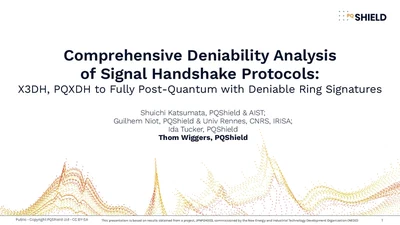
Conference talk presenting a unified framework for deniability analysis of Signal handshake protocols, including a deniable ring signature from Falcon/MAYO.
I recently wanted to use Emoji in a paper, but I did not want to force my contributors into using LuaLaTeX or XeLaTeX (in which you can just use fancy fonts). So as a work around, …
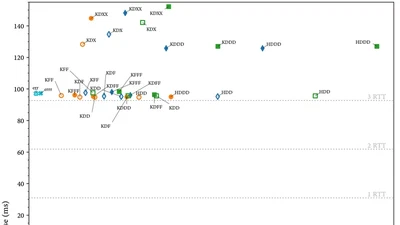
Recently, I have computed the sizes and measured the performance of post-quantum TLS (both PQ key exchange and post-quantum authentication). In these experiments, I have examined …
After I found myself in a vacation rental with Bas and Joost, we thought it would be fun to have a go at a few of hxp’s 2022 2023 ctf challenges as team #RU (long story relating to …
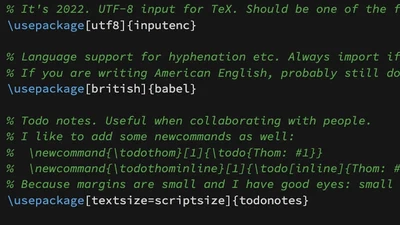
After a discussion on twitter I decided I should write down a few of the tips and tricks I’ve learnt over the years of writing papers and many other things in LaTeX.
If you’re curious about some of the things I’ve worked on while at Cloudflare, see this post on Cloudflare’s internal blog.
An introduction to formal analysis and our proof of the security of KEMTLS.
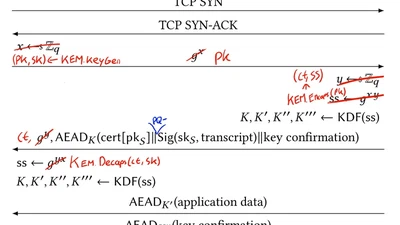
Post-quantum key exchange and signature algorithms come with different trade-offs that we’re not used to. How do we handle that when updating protocols, and is this an opportunity …
A brief overview of three to-do/project management apps.
Douglas and I appeared on Nadim's new podcast ‘Cryptography FM’ to talk about KEMTLS
This article previously appeared in Thalia’s Thabloid, in the 2019–2020 issue number 5. It was written at the end of May and may not reflect current practice at Radboud University. …