Post-Quantum Cryptography

TLS → Post-Quantum TLS: Inspecting the TLS landscape for PQC adoption on Android

The ubiquitous use of smartphones has contributed to more and more users conducting their online browsing activities through apps, rather than web browsers. In order to provide a …

dimitri-mankowski
Post-quantum TLS experiments featured image

Post-quantum TLS experiments

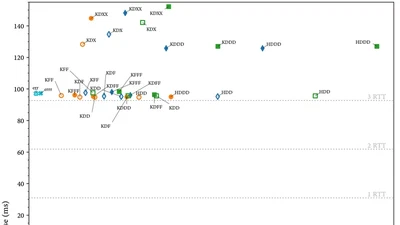
Recently, I have computed the sizes and measured the performance of post-quantum TLS (both PQ key exchange and post-quantum authentication). In these experiments, I have examined …

avatar
Thom Wiggers

A tale of two models: formal verification of KEMTLS in Tamarin

We prove the security of KEMTLS in two Tamarin models. One mode is based on the Cremers et al. model of TLS 1.3; the other closely resembles our pen-and-paper proofs. These models …

Sofía Celi

Improving Software Quality in Cryptography Standardization Projects

The NIST post-quantum cryptography (PQC) standardization project is probably the largest and most ambitious cryptography standardization effort to date, and as such it makes an …

Matthias J. Kannwischer

Implementing and Measuring KEMTLS

KEMTLS (CCS 2020) is a novel alternative to the Transport Layer Security (TLS) handshake that integrates post-quantum algorithms. It uses a key encapsulation mechanism (KEM) for …

Sofía Celi

Practically Solving LPN

We analyse the difficulty of the LPN problem in restricted memory.

avatar
Thom Wiggers
Solving LPN Using Large Covering Codes featured image

Solving LPN Using Large Covering Codes

Since quantum computers are expected to break most of the cryptographic schemes we rely on today, we need to look at alternatives. Learning Parity with Noise (LPN) is mathematical …

avatar
Thom Wiggers