Extended Key Update FATT Report
I presented a Formal Analysis Triage Team report on Extended Key Usage (EKU) in the TLS working group session.

I presented a Formal Analysis Triage Team report on Extended Key Usage (EKU) in the TLS working group session.
In deze presentatie vertel ik over TLS en hoe het op dit moment gaat met de transitie naar post-quantum cryptografie. Post-quantum key exchange wordt al uitgerold, maar …
The TLS protocol (famous for `https://`) is perhaps the most-used cryptographic protocol. As such, it is extremely important that it gets migrated to post-quantum cryptography. …
I gave a guest lecture on TLS and the challenges and ongoing efforts to make it work with post-quantum primitives.
We propose higher-security parametersets of CSIDH, and present highly-optimized implementations. We measure the performance when using these parameters in TLS, and show that the …
I gave an overview of the challenges for transitioning TLS to PQC, and highlighted a number of proposals to mitigate the impact of large post-quantum signatures.
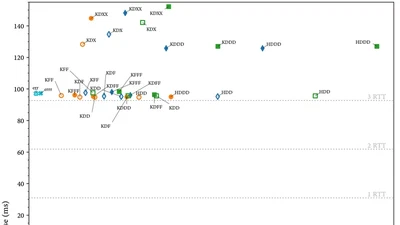
Recently, I have computed the sizes and measured the performance of post-quantum TLS (both PQ key exchange and post-quantum authentication). In these experiments, I have examined …
Invited lecture about TLS, its history and making TLS post quantum. I also discuss KEMTLS.
We make KEMTLS more efficient in scenarios where the client already has the server's long-term public key, for example through caching or because it's pre-installed.
KEMTLS (CCS 2020) is a novel alternative to the Transport Layer Security (TLS) handshake that integrates post-quantum algorithms. It uses a key encapsulation mechanism (KEM) for …